

The suspected attack on Binance is the biggest development overnight. On-chain tallies show at least $5.57 billion left wallets tied to the world's largest exchange, which would be the largest crypto hack on record if confirmed. Bitcoin slid toward $77,000, BNB lost about 7% and futures liquidations surged.
Binance drained of more than $5.5 billion
The first transaction came at 20:24 UTC on Oct. 29 (3:24 a.m. Vietnam time on Oct. 30): 167,464 ETH plus 63 tokens, including 1.615 billion USDT, moved to a fresh address. The funds came from hot wallets, the internet-connected wallets an exchange uses to process customer withdrawals. The on-chain tally counts $3.51 billion on Ethereum, $1.44 billion (18,270 BTC) on Bitcoin and $630 million on Tron. Estimates range from $5.5 billion to $5.8 billion and have not been fully reconciled.
Three minutes before that first transfer, an address funded through Tornado Cash submitted a delegation for a Binance hot wallet using EIP-7702, a feature that lets an ordinary wallet run smart-contract code. Security researchers say the code effectively turned the wallet into a sweeper. How the attacker obtained the needed signature is unknown; some experts suspect the exchange's transaction-signing infrastructure was manipulated rather than keys being stolen in the usual sense.
Binance said it is investigating and initially did not confirm any impact on user funds. Co-CEO Yi He later said user funds are protected by the exchange's SAFU reserve, and founder Changpeng Zhao said he expects users to be made whole. Binance's own proof-of-reserves data lists one of the drained wallets among those backing customer balances, which leaves ETH backing at an estimated 94% until the exchange replaces the missing assets. Its next reserve snapshot is due Nov. 1.
Stablecoins frozen as the attacker looks for exits
Tether said it froze more than $1.567 billion in USDT, Circle about $823 million in USDC, Ripple about $200 million in RLUSD, World Liberty Financial $27 million in USD1 and Paxos more than $8 million in tokenized gold (PAXG). The total tops $2.6 billion, roughly half of what was taken.
The rest is harder to hold. On-chain records show the attacker swapping freezable stablecoins for ETH, which no issuer can lock, on decentralized exchanges such as Uniswap. One wallet also deposited $60 million in USDT on Aave to borrow about 19,800 ETH. Aave froze its V3 markets on Ethereum and Kamino paused borrowing in its SOL and BTC markets. Around 22:07 UTC, about 253,000 ETH (roughly $570 million) sat in two wallets with no outgoing transfers.
Prices, liquidations and the macro backdrop
Bitcoin hit an intraday low of $78,297 on Binance spot on Oct. 29, then kept sliding. On Binance's 1-hour BTC/USDT chart, price was near $77,100, with the latest low around $76,760. Ether fell about 4% to near $2,260 at 23:24 UTC, and the total crypto market capitalization dropped 3.3% to about $2.73 trillion. Monero rose about 6% to $637, echoing moves after past large thefts.
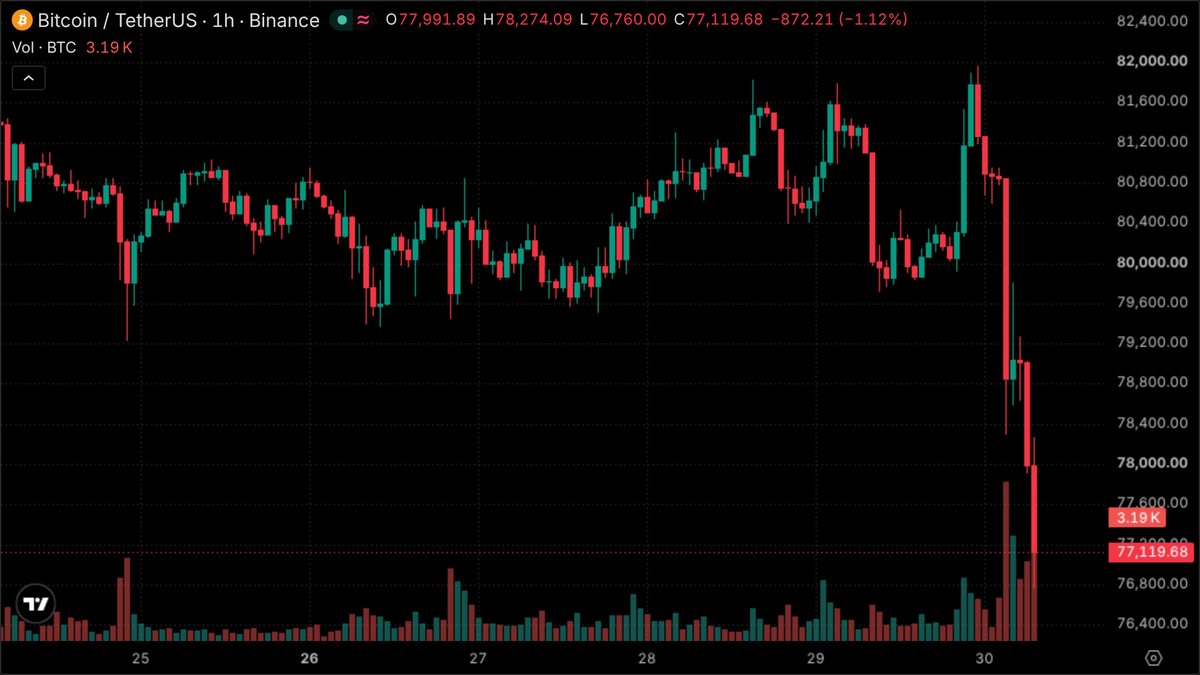
Liquidation data shows nearly $1 billion wiped out over 24 hours, including about $532 million in a single hour, with $289 million in BTC positions and $236 million in ETH positions. Bitcoin was already weak before the first transfer: it traded below $80,000 on Oct. 29 as tech stocks sold off and markets read the Fed's hold as hawkish. The Fed kept rates at 3.75%–4.00% in a 10–2 vote, with two members voting to hike. The 10-year Treasury yield sat just under 5%, down from 5.05% at Wednesday's close.
ETF flows before the incident were constructive: U.S. spot Bitcoin ETFs took in about $424 million net from Monday to Wednesday this week, after $635 million of net outflows on Oct. 22. Still, the funds' average cost basis is estimated at roughly $81,500–$82,000, so Bitcoin now trades below it. On-chain analysis also shows about 4 million BTC bought between $85,000 and $118,000, and the $84,000–$85,000 band has turned Bitcoin back four times this year.
Other notable news
Today is also expiry day for about $11 billion in Bitcoin options on Deribit, roughly a third of the exchange's open Bitcoin options. Max pain sat near $78,000 and about 86% of contracts were out of the money when the data was published. Separately, Polymarket paused trading after a third-party provider was breached, with about $2.65 million drained; it then moved to cancel-only mode.
What it means for traders
For futures traders, the Binance incident stacks two risks: sharp price swings and counterparty risk. Nearly $1 billion of liquidations in 24 hours shows how quickly high leverage gets swept when prices fall fast; in such sessions funding rates and open interest tend to move sharply, and wide spreads and slippage can fill orders far from the expected price. Verified funding and open interest figures were not available for this move, so traders should check both on the platform they use.
What to watch next: whether Binance publishes a total loss figure and a plan to cover it, whether the Nov. 1 reserve data shows backing restored, whether the attacker's ETH keeps moving, and whether today's options expiry adds to volatility. Open positions on Binance carry operational risk that is still unclear, so risk management and position size come first. Position and liquidation-price calculators are on the tools page, and exchange comparisons are in the exchange ranking.