
When opening a futures position, the question of where to place a stop loss is often answered by instinct: a loss level that "feels bearable," or a round price that looks reassuring. This article explains why that approach often backfires, and how to set a stop loss based on each coin's real volatility range, measured with the ATR (Average True Range) technical indicator.
Why a gut-feeling stop loss often fails
A stop loss chosen by feel (for example, "I'll stop at a 3% loss") ignores the fact that different coins swing by very different amounts within the same timeframe. A coin that normally moves 4-5% within a single hour will likely get stopped out by its own ordinary noise if the stop is placed only 2-3% away from entry, even when the underlying trend hasn't actually reversed. Conversely, placing the stop too far on a coin with naturally low volatility needlessly widens the risk taken on each trade.
What ATR is, and why stops should follow it
ATR (Average True Range) is a technical indicator that measures an asset's average volatility range over a given timeframe, calculated from real candle data rather than estimated by eye. A higher ATR means the coin typically swings more within a normal hour or day.
Setting the stop loss as a multiple of ATR (for example, 3x or 4x the 1-hour ATR) means the distance between entry and stop scales with how much that specific coin naturally moves. This keeps the stop far enough away to avoid being triggered by ordinary noise, while preventing it from being arbitrarily widened based on how the trader feels in the moment.
Alongside an ATR-based stop, a fixed risk:reward ratio (R:R) is set before entering the trade — for example, R:R = 2 means the take-profit target is twice as far from entry as the stop loss. Defining both the risk (stop loss) and the expected reward (take profit) at a fixed ratio before entering means a trader knows the maximum possible loss in advance, rather than discovering it after the fact.
A real example: a ZEC short stopped out exactly as planned
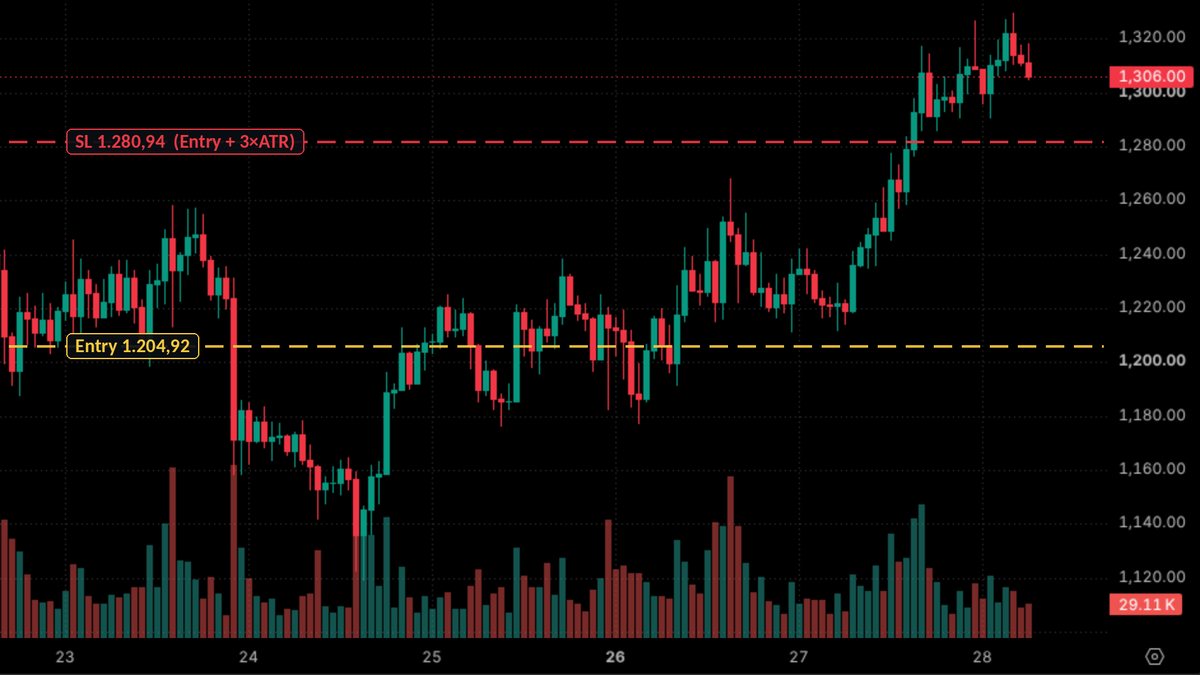
A real short position on ZEC (Zcash) was opened at 1,204.92 USDT on October 26, 2026. The stop loss was set at 1,280.94 USDT — exactly three times the 1-hour ATR at the time of entry, not a round number chosen by feel.
- Entry price: 1,204.92 USDT
- Stop loss: 1,280.94 USDT, equal to 3x the 1-hour ATR
- What happened: about 32 hours later, the 1-hour candle at 14:00 on October 27, 2026 printed a high of 1,284.55 USDT, breaking above the stop level
- Result: the trade closed at a loss of 1.05 times the initial risk (-1.05R), with the extra 0.05 coming from round-trip trading fees, not from the price moving further than planned
What stands out in this example isn't that the trade lost — it's that the loss amount was known precisely from the moment the trade was placed. The stop wasn't moved as price developed, and the take-profit target was fixed at the same predetermined ratio from the start. A loss that happens exactly according to plan is very different from a loss where the trader never knew how much risk they were carrying.
Common mistakes when placing a stop loss
Two opposite mistakes are most common among new futures traders:
- Setting the stop too close to entry to keep the dollar loss small. This usually results in the stop being hit by the coin's own ordinary noise within its ATR range, even when the original trend direction was correct.
- Moving the stop further away once price approaches it, hoping for a reversal. This turns a trade with a predefined risk into one with no real loss limit, and erases the entire reason the stop was set using ATR in the first place.
Position size should also be derived from the stop distance that's already been set, not the other way around. Once a trader knows the stop distance as a percentage of entry price, they can size the position so that hitting the stop doesn't meaningfully damage the overall account.
In summary
Setting a stop loss based on each coin's ATR, rather than on instinct or a round number, keeps the stop far enough to avoid ordinary noise while grounding it in real data instead of feeling. Combined with a fixed risk:reward ratio decided before entry, a trader always knows the maximum risk on every trade, win or lose. Beginners can use the position-sizing and liquidation-price tool on CoinHammy's tools page to estimate the right position size for a given stop distance.