
Many traders place careful stop losses and still lose too much on a single trade because the position size was picked by feel. This guide answers one question: how to calculate futures position size from a fixed risk amount, so a stopped-out trade costs only the share of capital planned in advance.
Risk per trade is not the same as position size
Risk per trade is the amount lost if price reaches the stop loss. Position size is the total value of the open position. They are different numbers: on the same 1,000 USDT position, a stop 0.5% away risks about 5 USDT, while a stop 5% away risks about 50 USDT.
So the first thing to fix is the percentage of capital you accept losing on each trade. Many traders use 1%, and beginners often use less. Position size is then worked backward from the distance to the stop.
The position sizing formula
The calculation has three steps and works for both long and short trades:
- Amount at risk = account balance × risk percentage. With 1,000 USDT and 1% risk, that is 10 USDT.
- Stop distance = the gap between entry and stop price in dollars. It is best based on ATR (average true range, the typical price swing) rather than a fixed percentage.
- Position size = amount at risk ÷ stop distance, in coins.
Leverage does not appear in the formula. Leverage only sets how much margin is needed to open the position; the loss at the stop is set by size and stop distance.
A worked example on real Bitcoin candles
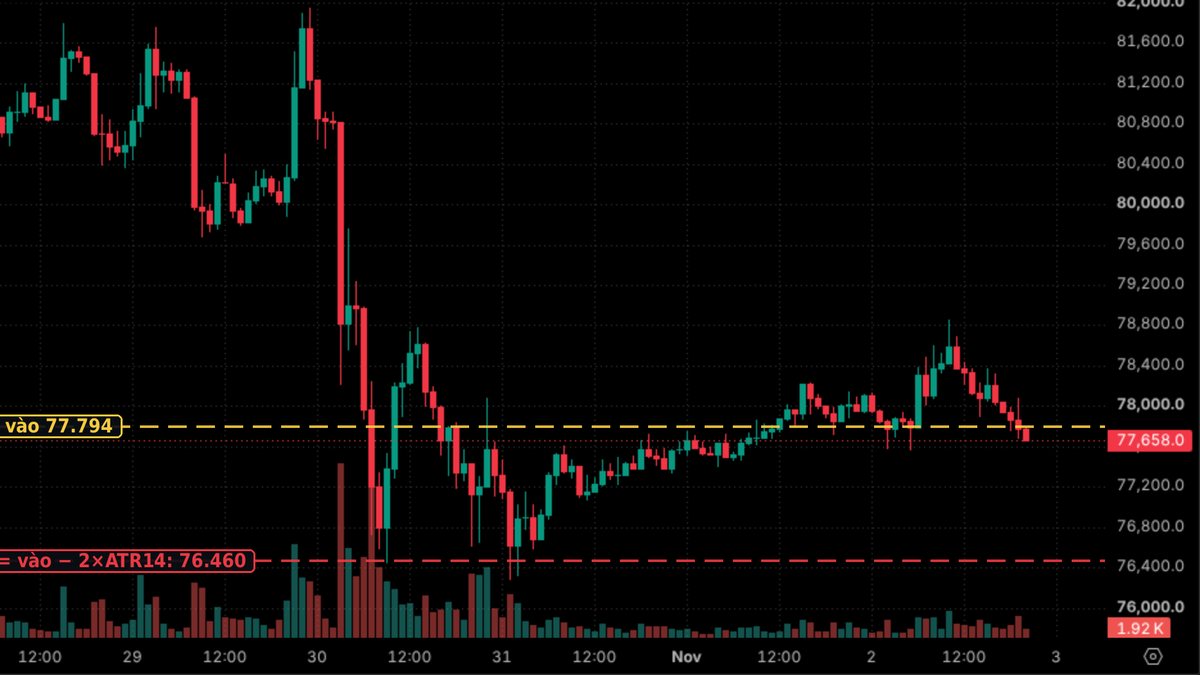
The example below uses 1-hour BTCUSDT candles and only illustrates the math; it is not a trade to copy. The candle that opened at 17:00 on 30 October 2026 (Vietnam time) closed at 77,794.1 USD. Its ATR14, smoothed the Wilder way, was 666.9 USD. With the stop placed 2×ATR below entry, the stop price is 77,794.1 − 2 × 666.9 = 76,460.3 USD, a distance of 1,333.8 USD (about 1.71% of entry).
Assume a 1,000 USDT account and 1% risk, which is 10 USDT. Position size = 10 ÷ 1,333.8 ≈ 0.0075 BTC, a position worth about 583 USDT, smaller than the account itself, so high leverage is not needed.
What happened next: during the 1-hour candle that opened at 01:00 on 31 October, price printed a low of 76,270 USD, through the 76,460.3 stop. With 0.0075 BTC, the stop-out loss is roughly 10 USDT, exactly the 1% planned beforehand.
Compared with sizing by feel
With the same entry and stop, a trader who picked 0.05 BTC because it is an easy round number would lose 0.05 × 1,333.8 ≈ 66.7 USDT at the stop, about 6.7% of the account. Same stop, same idea, a result more than six times larger purely because of sizing.
| Sizing method | Size | Loss at stop | Share of account lost |
|---|---|---|---|
| Risk-based, 1% | 0.0075 BTC | about 10 USDT | about 1% |
| By feel | 0.05 BTC | about 66.7 USDT | about 6.7% |
Losing streaks are normal. At 1% per trade, five straight losses cost about 5% of the account; at 6.7% per trade, five losses can cost roughly 30%, and winning it back requires a gain of about 43%.
Common sizing mistakes
- Sizing by margin instead of stop distance. Using "the whole margin" or "a third of the account" on every trade makes the real risk change with the stop.
- Moving the stop further away after entry. A wider distance with the same size means more risk than planned.
- Ignoring fees and slippage. They make the real loss slightly larger than the calculation, so treat 1% as approximate.
- Raising risk after a losing streak to win it back. This is emotional trading and usually deepens the loss.
To test the numbers with your own balance, try the calculator tools on CoinHammy.
Summary
Position size should be worked backward from three inputs: account size, accepted risk percentage, and an ATR-based stop distance. In the Bitcoin example above, this keeps the stop-out loss near 10 USDT, while sizing by feel could push the loss past 66 USDT with the same stop.